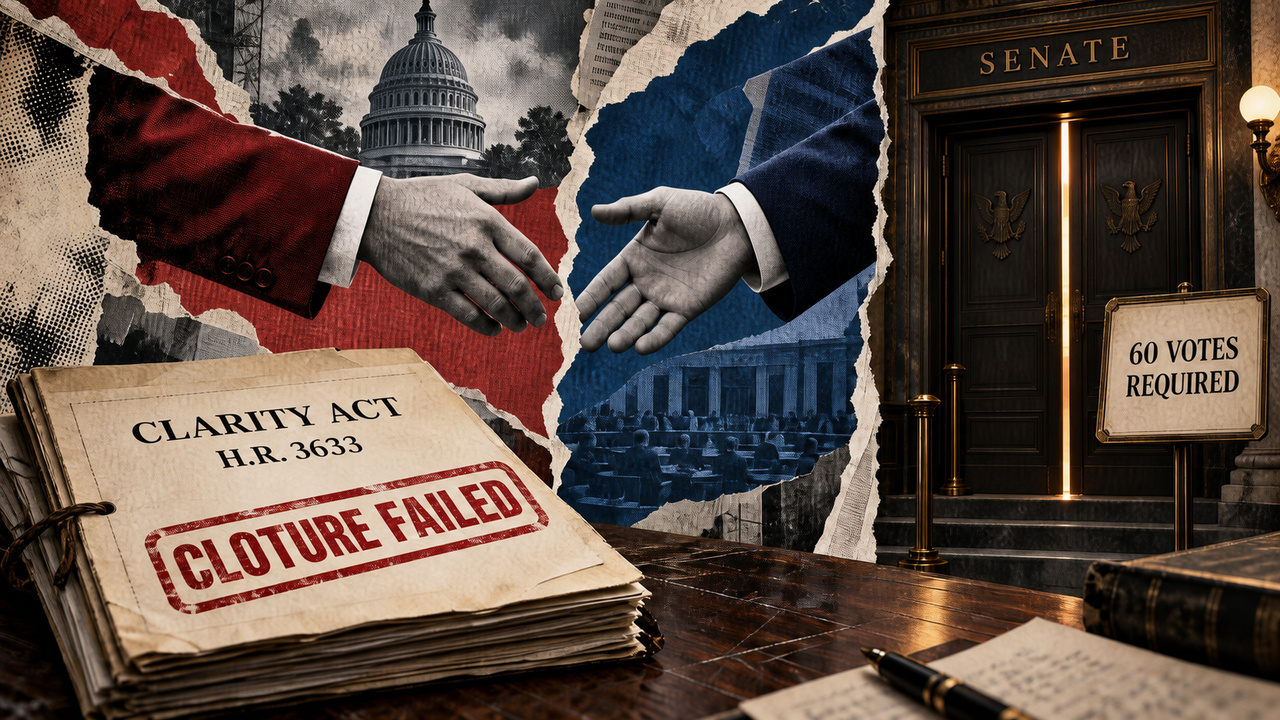
The US Senate's rejection of the CLARITY Act (H.R. 3633) stems from a total breakdown in bipartisan negotiations triggered by a contentious fight over ethics provisions tied to Donald Trump. Despite earlier momentum, several key Democrats who originally helped shape the legislation refused to advance it during the final cloture vote, preventing the bill from reaching the floor for a full vote. This legislative failure means that the long-awaited definitions for digital asset categories and the division of authority between the SEC and CFTC remain unresolved.
The collapse of the bill highlights the deep political divisions that continue to haunt crypto policy in 2026. While H.R. 3633 was intended to provide a stable legal environment for domestic exchanges and stablecoin issuers, the insertion of unrelated ethics mandates effectively poisoned the well for the 60-vote majority needed to move forward. Lawmakers who withdrew their support cited concerns that the bill's broader political baggage outweighed its benefits for the financial sector.
For the US crypto market, this stalemate signals a return to a high-pressure environment of regulation-by-enforcement. Without the CLARITY Act's provisions to streamline registration for digital asset platforms, companies like Coinbase and Kraken will likely remain locked in protracted legal battles with federal regulators. Investors should expect continued volatility as market participants grapple with the reality that a comprehensive federal 'rulebook' for crypto is unlikely to pass before the next election cycle.
Looking ahead, market analysts are watching whether individual states will move to fill the regulatory vacuum left by the Senate's inaction. There is also potential for the administration to issue new executive orders to address Immediate risks in the stablecoin market, though these lack the permanence of the failed legislation. For now, the focus shifts back to the judicial branch, where major court rulings may become the de facto law for the US crypto industry in the absence of a successful act of Congress.