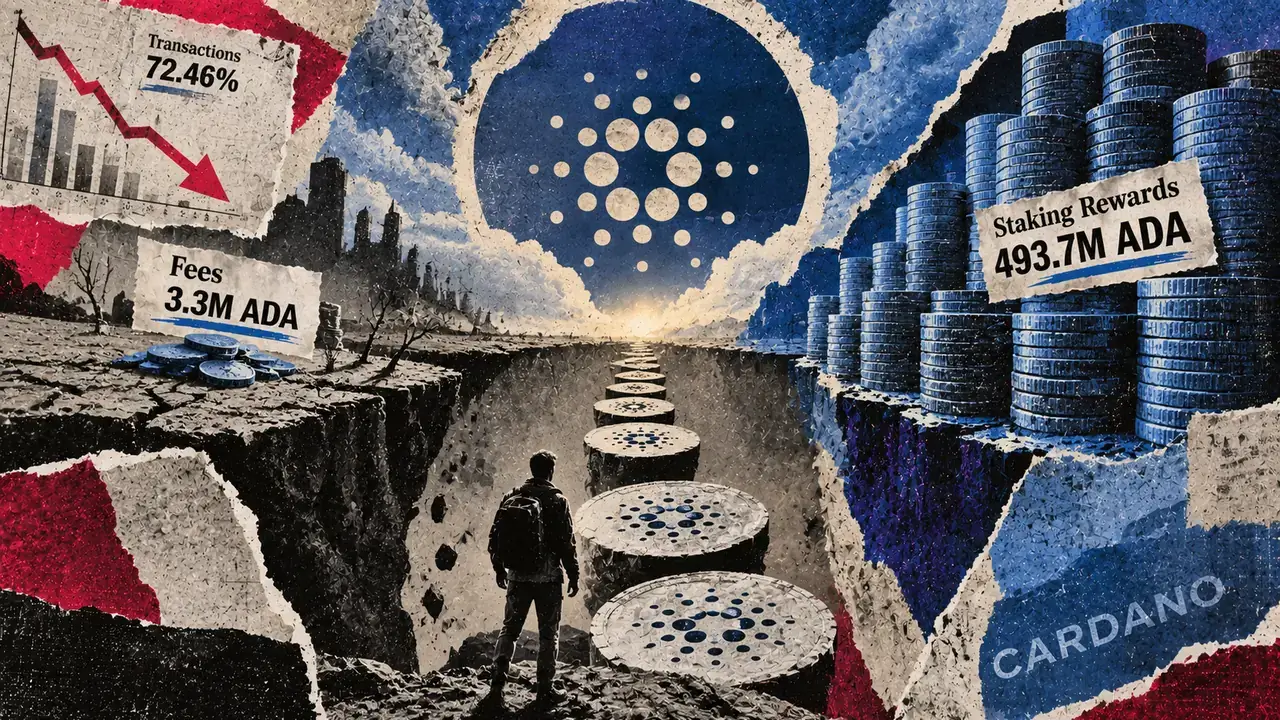
Cardano’s staking model is facing a critical sustainability test in early 2026 as transaction fees currently cover less than 1% of the rewards distributed to network participants. The upcoming Leios upgrade, designed to significantly increase Cardano's block processing capacity and throughput, provides the necessary infrastructure for massive growth; however, it does not inherently generate the user demand required to close the 150-fold gap between current fee revenue and staking payouts. Without a surge in paying transactions, the network remains dependent on finite treasury reserves to incentivize validators and stakers.
Recent on-chain data reveals a sharp 72% decline in transaction volume, which has exacerbated the revenue shortfall. This drop-off indicates that despite Cardano's technical maturity and the rollout of its Voltaire governance era, the ecosystem is struggling to convert its academic and technical milestones into commercial utility. For stakers, this means the current yield is largely inflationary or subsidized, a model that faces diminishing returns as the project's reserve funds are gradually depleted over time.
In the current 2026 regulatory environment, US-based institutional investors are increasingly prioritizing 'organic yield'—revenue generated from actual network usage—over inflationary rewards. As the SEC and other regulators refine their stance on Proof-of-Stake (PoS) assets, networks that can prove economic self-sufficiency are likely to be viewed more favorably. Cardano's inability to capture significant fee revenue despite its high market capitalization presents a potential headwind for ADA’s inclusion in more conservative institutional portfolios.
Moving forward, the success of the Leios implementation will be measured not just by its Transactions Per Second (TPS) capabilities, but by its ability to attract high-value DeFi protocols and enterprise-grade applications. Investors should closely monitor the 'fee-to-reward' ratio following the Leios launch. A failure to see a corresponding spike in network activity would suggest that Cardano’s scaling solutions are solving a capacity problem that the market does not yet demand, potentially leading to a re-evaluation of ADA’s long-term value proposition.