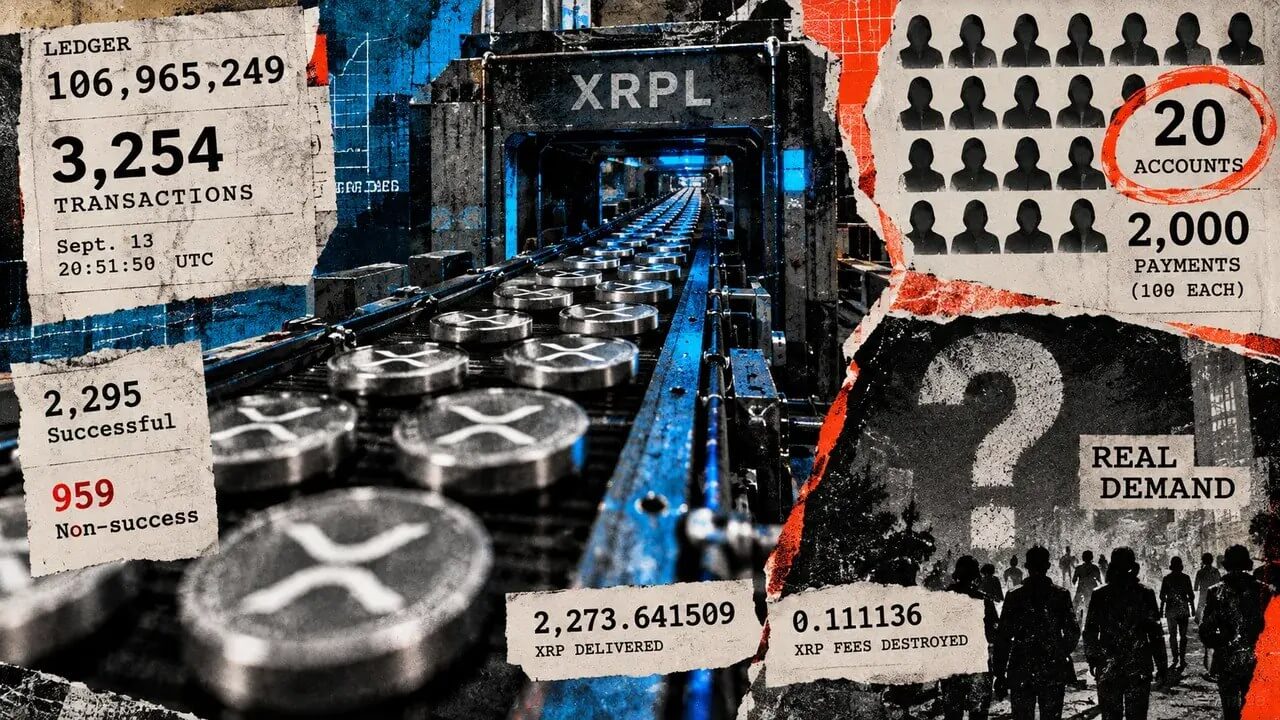
The XRP Ledger (XRPL) achieved a technical milestone in early January 2026 by clearing a throughput of over 3,000 transactions per second (TPS), but analysts have labeled the surge as 'synthetic' traffic. The activity was primarily driven by a script executing 2,000 'one-drop' payments—the smallest possible unit of XRP—originating from only 20 distinct accounts. This controlled environment allowed the network to reach high speeds without the friction of complex smart contracts or the varied data payloads typical of organic institutional use.
Technically, the test proved that the XRPL consensus mechanism can stay synchronized under high volume, but the economic impact was negligible. Because the transactions involved such small amounts of XRP, the total fee burn was minimal, failing to demonstrate how the network would handle the cost-averaging or priority queuing required during a real-world liquidity crunch. For a network marketing itself as the premier layer for global cross-border settlements, a test involving only 20 accounts offers little evidence that the ledger can support thousands of simultaneous institutional participants.
From a market perspective, this event highlights the ongoing tension between blockchain marketing and actual utility in 2026. As Ripple continues to court central banks for CBDC projects, these high TPS numbers are often used as a headline metric to compete with high-speed networks like Solana or Aptos. However, US-focused investors are increasingly looking past 'vanity metrics' and demanding proof of 'complex throughput'—transactions that involve multi-signature requirements, Escrow finishes, and Automated Market Maker (AMM) interactions.
Looking ahead, the XRP community should watch for upcoming stress tests that incorporate 'diverse payloads' or actual decentralized finance (DeFi) activity. For the 3,000 TPS figure to be meaningful for Ripple’s 2026 enterprise strategy, the network must demonstrate similar performance levels with real-world distribution patterns. Until then, the XRPL remains technically fast but practically unproven at this specific scale for diverse, high-value financial applications.