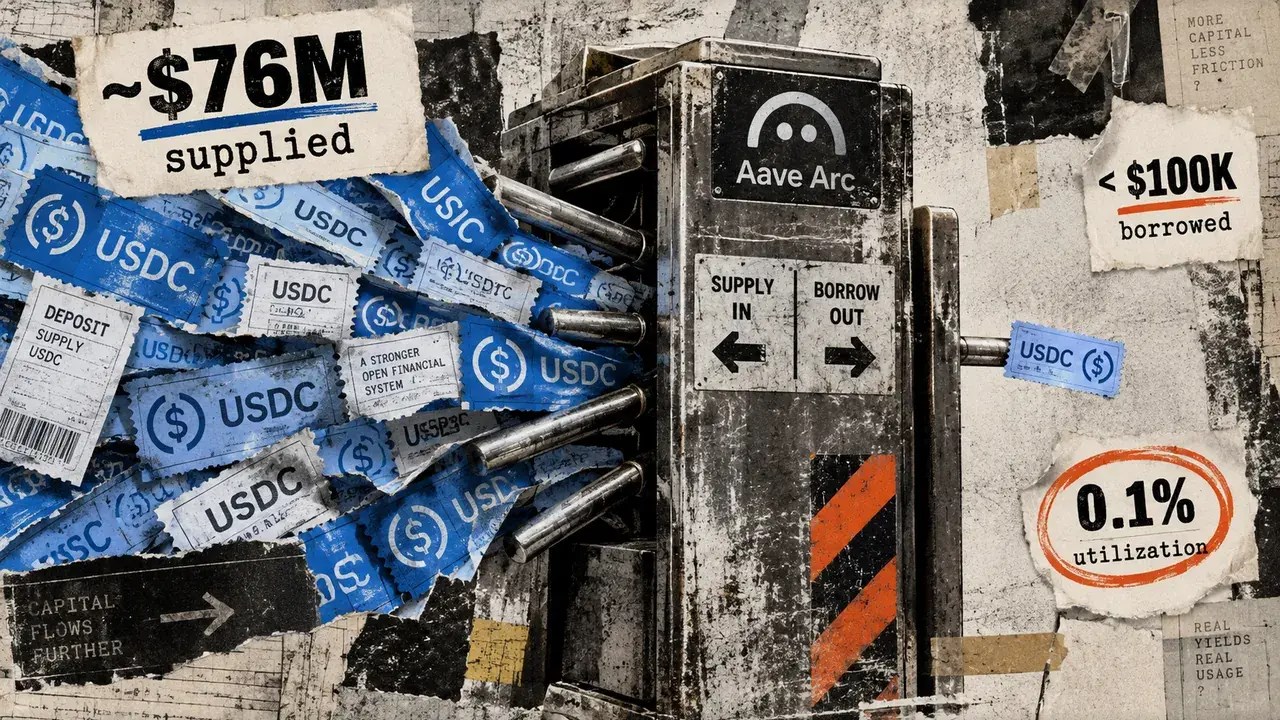
The near-zero utilization of USDC on Aave V4’s Arc market is the result of a massive imbalance between institutional liquidity providers and qualified borrowers. While lenders have deposited $76 million to capitalize on the security of the V4 protocol, the pool of KYC-verified borrowers authorized to tap into this capital has not yet scaled. This has left the market 'swimming' in idle stablecoins, with the total borrowed amount hovering below a negligible $100,000.
This trend highlights a friction point in the 2026 institutional DeFi landscape. The Aave Arc market was specifically designed to meet US regulatory standards by restricting participation to whitelisted entities. However, the current data suggests that the demand for permissioned on-chain credit is not keeping pace with the rapid influx of institutional capital seeking yield. For lenders, this low utilization translates to extremely low interest rates, as there is almost no one to pay for the cost of capital.
From a regulatory perspective, this situation underscores the challenges of 'walled garden' DeFi. While US-focused crypto intelligence suggests that compliance is necessary for adoption, the Arc market's lack of activity shows that strict onboarding requirements may be choking off the very utility that makes DeFi attractive. Investors are watching to see if Aave governance will lower the barriers for institutional debtors or if the capital will eventually rotate back into permissionless V4 pools.
In the coming months, the market should monitor for updates to the Aave Arc whitelisting process and the potential integration of Real World Assets (RWAs) as collateral. If credit demand does not materialize, the $76 million surplus may migrate to competing institutional lending protocols that offer better capital efficiency. The success of Aave V4 hinges on its ability to turn this massive supply into a functional credit market rather than just a vault for idle USDC.