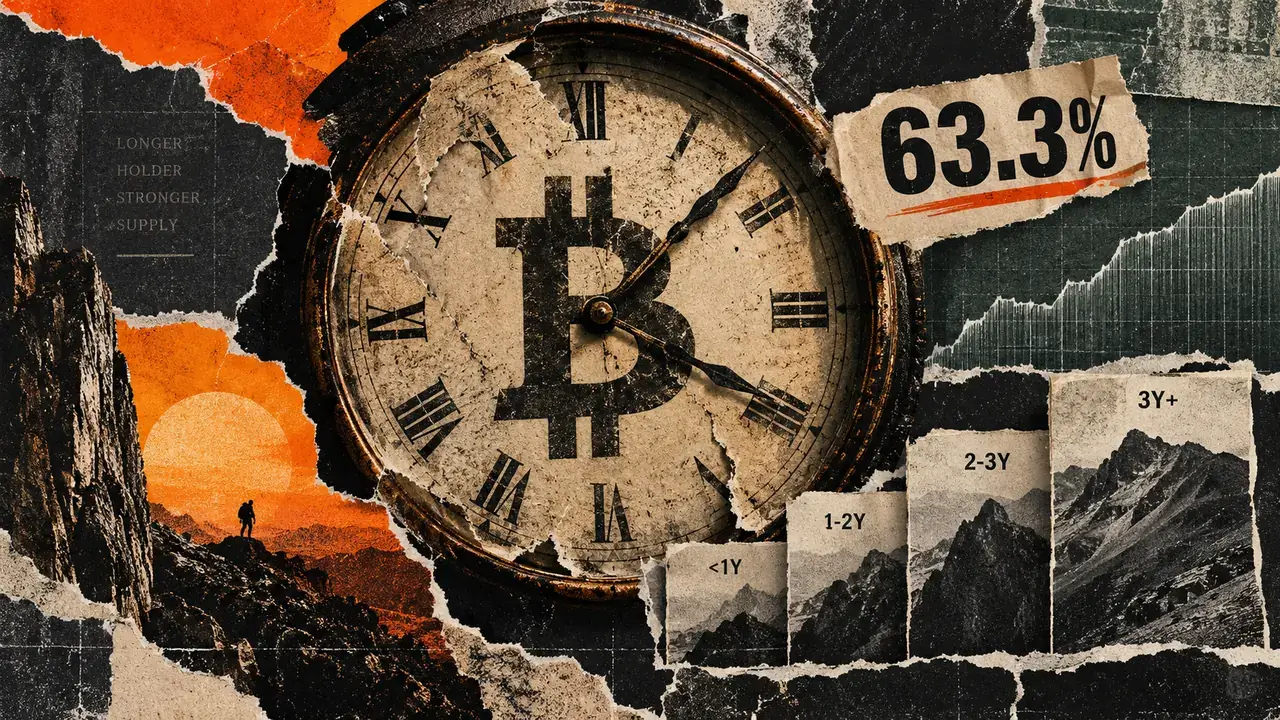
The 1-year Bitcoin HODL wave hitting the 63% mark is not the definitive bullish signal many investors assume because the recent 0.98 percentage point increase is primarily a result of coins shifting between adjacent age bands. Specifically, coins that were acquired roughly 12 months ago are simply maturing into the one-year-plus category. This statistical rollover means that the increase is a lagging indicator of past holding behavior rather than a proactive signal of current market conviction or a sudden reduction in liquid supply.
Data from the last month shows that as the one-year share rose, adjacent age brackets—particularly the 6-12 month band—saw a corresponding shift. This suggests that the market isn't necessarily seeing a fresh wave of 'diamond hand' accumulation. Instead, the supply is merely crossing a chronological threshold. For this to be a 'mega bull' signal, analysts would need to see a broad decrease in exchange balances and a simultaneous rise in older age bands (2-5 years), which would indicate a deeper, multi-year supply lock-up.
In the current 2026 market environment, misinterpreting HODL waves can lead to a false sense of security regarding supply scarcity. If these 'new' one-year holders are actually traders who were sidelined during previous volatility, they may still be looking for an exit as Bitcoin approaches key resistance levels. This 'passive' holding doesn't provide the same price floor as active, strategic accumulation by institutional entities or long-term whales.
Investors should watch for a divergence between the HODL wave and the Spent Output Profit Ratio (SOPR). If the HODL wave continues to grow while SOPR remains low, it indicates that holders are staying put despite being in profit—a much stronger bullish signal than a simple age-band shift. For now, the 63% figure should be treated as a neutral statistical milestone rather than a catalyst for an immediate price breakout.