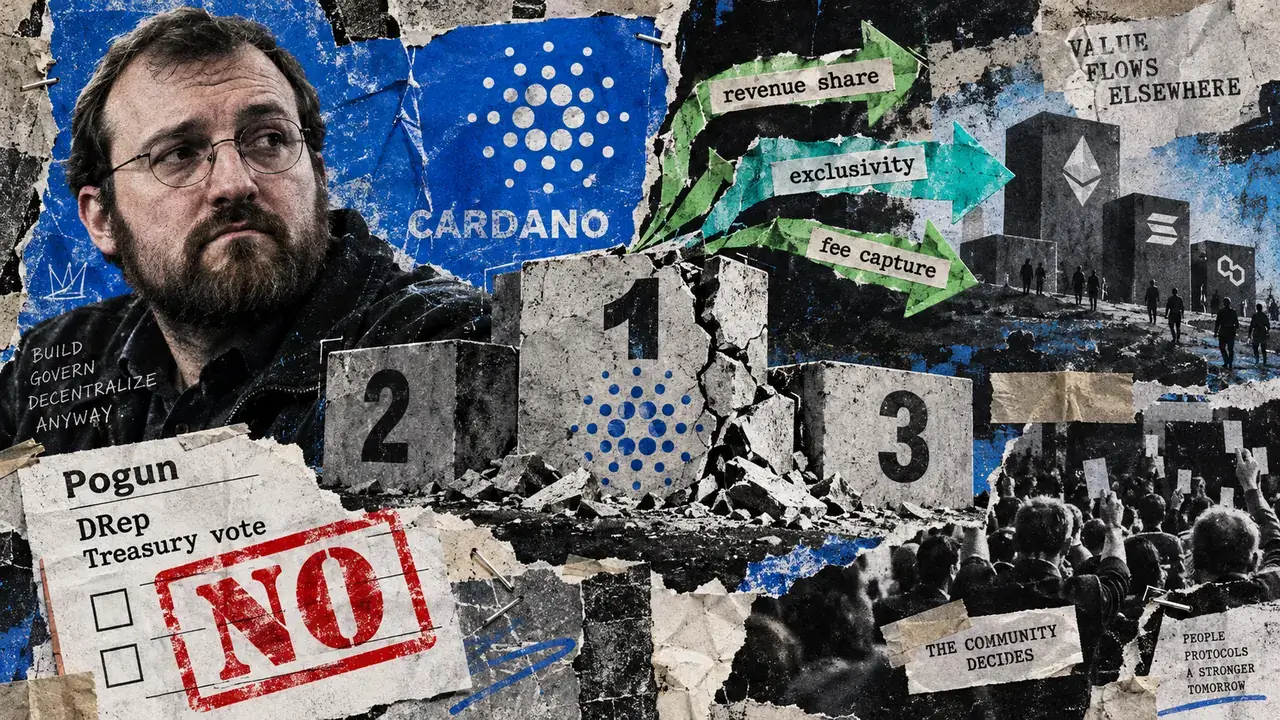
The Cardano community’s decision to reject the Pogun proposal, which sought a withdrawal of 12.29 million ADA, marks a definitive shift toward decentralized governance where even founder-linked initiatives are subject to rigorous voter scrutiny. This rejection has prompted Charles Hoskinson to clarify that Input Output Global (IOG) will no longer treat Cardano as the default substrate for all future technical products. The move signals that the 'Cardano-first' era has ended in favor of a market-driven approach where IOG will evaluate various blockchains for new launches based on project-specific needs.
The Pogun rejection serves as a milestone for Cardano’s governance model, proving that the treasury is no longer a rubber stamp for development requests. Voters cited concerns regarding the proposal's transparency and the immediate utility of the 12.29 million ADA expenditure. For Hoskinson and IOG, this democratic friction has led to a strategic pivot. While Cardano remains a core focus, the announcement that future products will not automatically default to the network suggests IOG is preparing to compete as a cross-chain service provider in a more fragmented 2026 crypto landscape.
From a regulatory and market perspective, this independence could be a double-edged sword. In the United States, the SEC and other regulators have often scrutinized the level of control founders exert over decentralized networks; Cardano’s recent voting outcome provides a strong counter-argument to claims of centralization. However, the prospect of IOG launching premier products on competing chains may cause concern among ADA holders who previously relied on Hoskinson’s exclusive commitment to the ecosystem to drive token demand.
Investors and developers should now watch for the upcoming 'Voltaire' governance updates to see how the treasury handles subsequent high-value requests. The immediate market implication is a shift in ADA’s value proposition from a founder-led project to a community-governed infrastructure layer. If IOG begins deploying significant middleware or scaling solutions on other chains, Cardano will need to prove it can attract external talent to fill the gap left by its founding entity's new multi-chain agnosticism.