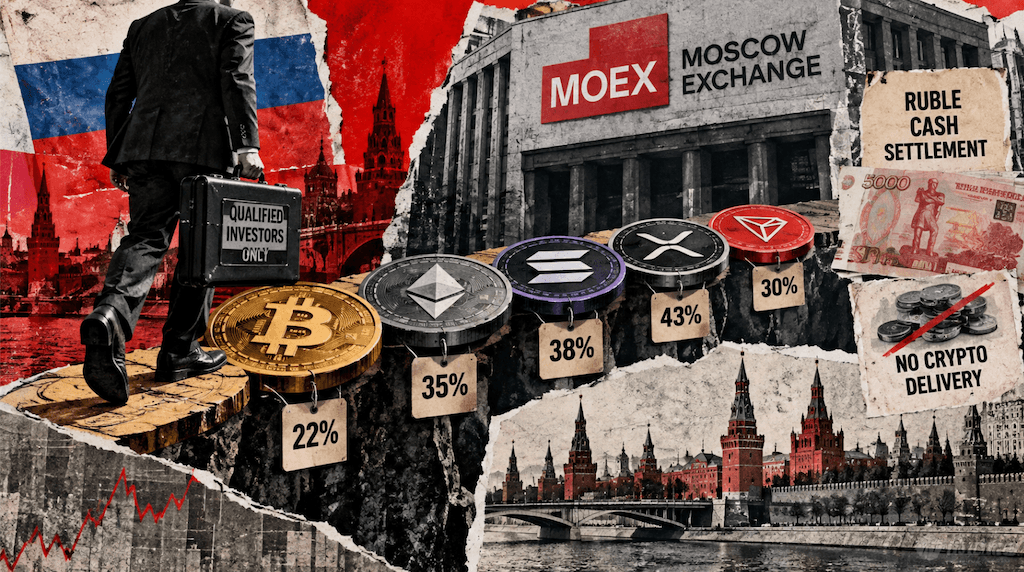
The Moscow Exchange (MOEX) has officially introduced perpetual futures for five major cryptocurrencies—Bitcoin (BTC), Ether (ETH), Solana (SOL), XRP, and Tron (TRX)—to meet a documented domestic demand of over 600 billion rubles. These new financial instruments allow traders to speculate on the price movements of these digital assets within a regulated framework. Crucially, the contracts are cash-settled in rubles, meaning that no actual cryptocurrency is delivered or held by the exchange or the participants, effectively isolating the trading activity from the global blockchain infrastructure.
This launch reflects a strategic shift by Russian financial authorities to capture the growing local interest in digital assets. By offering automatically rolling contracts, MOEX provides a user experience similar to the perpetual swaps found on global offshore exchanges, but with the added layer of domestic regulatory oversight. The move is particularly significant for institutional players in Russia who have been seeking legal avenues to hedge against currency volatility or gain market exposure without navigating the complexities of decentralized wallets or foreign platforms.
From a geopolitical perspective, the introduction of ruble-settled crypto derivatives is part of Russia's broader effort to build an autonomous financial ecosystem. As international sanctions continue to complicate traditional cross-border transactions, creating a robust domestic market for crypto-linked products helps retain local capital. While these instruments do not interact directly with global liquidity pools due to the lack of physical delivery, they signal a deepening integration of digital asset pricing into the national economy.
For the global market, the immediate impact on spot prices for Bitcoin or Solana is expected to be minimal, as the trades do not necessitate the purchase of the underlying coins. However, analysts should watch for whether this infrastructure serves as a precursor to more complex cross-border payment experiments involving digital assets. The growth of this 600 billion ruble market suggests that despite physical delivery restrictions, the appetite for crypto-denominated risk remains high in the region.