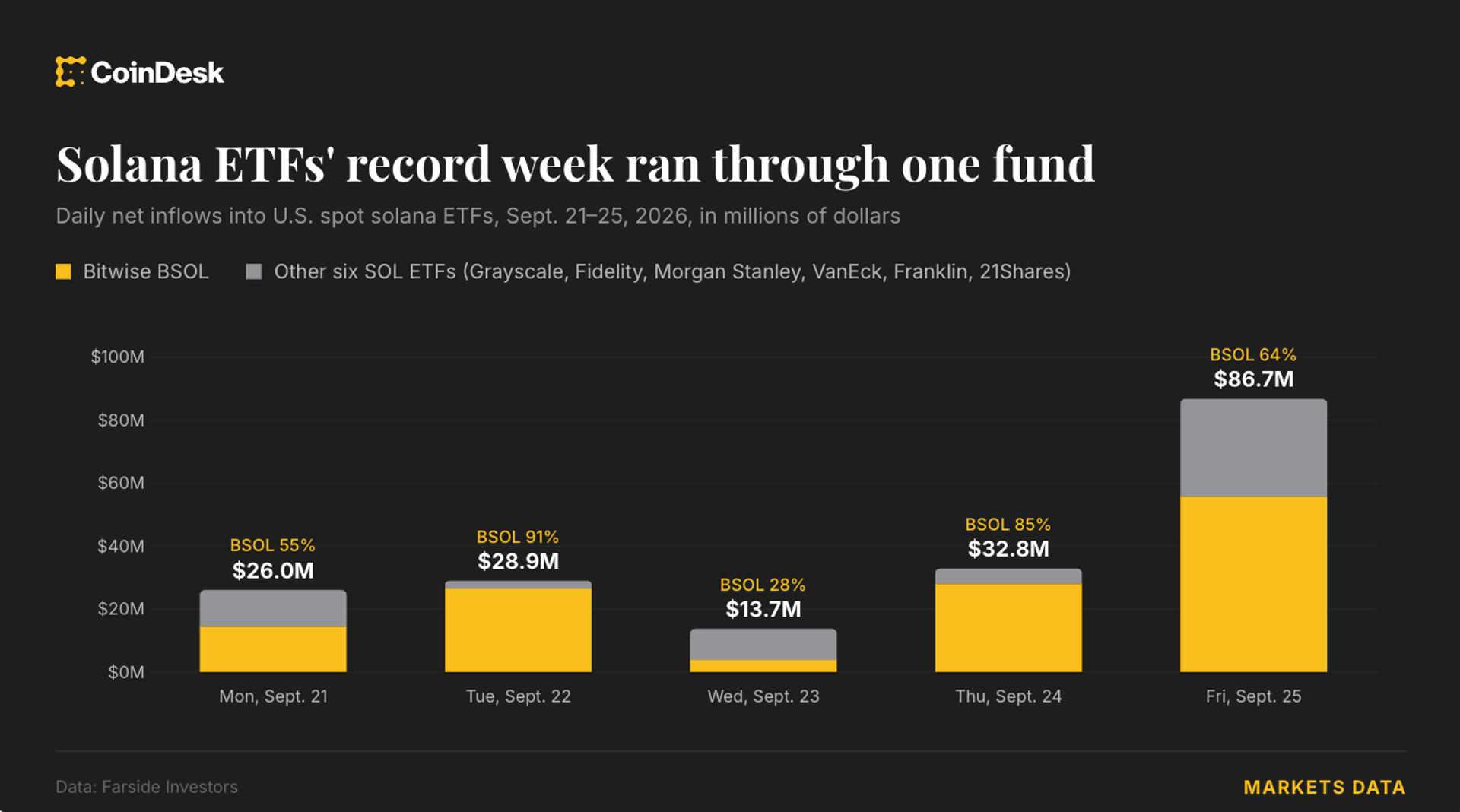
During the most recent trading week of 2026, Solana spot exchange-traded funds (ETFs) in the United States reached a new milestone with $188 million in net inflows. This record-breaking performance was bolstered by a massive $87 million intake on Friday alone, setting a new daily record for the asset class. The surge indicates that institutional investors are increasingly viewing Solana as a primary alternative to Ethereum for high-throughput blockchain exposure, particularly as the U.S. regulatory environment for spot altcoin products has stabilized earlier this year.
Bitwise emerged as the clear market leader during this period, securing approximately two-thirds of the total weekly inflows. While all seven active Solana ETFs attracted positive capital, Bitwise’s dominance suggests that its specific fund structure or distribution network is currently the preferred choice for large-scale wealth managers. This concentration of liquidity within a few top-tier providers is a trend that analysts have been tracking throughout the first half of 2026 as the competitive landscape for crypto ETFs matures.
From a regulatory and political standpoint, these inflows reflect growing confidence in the SEC's 2026 guidelines regarding proof-of-stake assets. With the clarification of how staking rewards are handled within ETF wrappers, institutional hurdles that previously hindered Solana's adoption have largely vanished. This has allowed U.S.-based pension funds and insurance companies to begin allocating to SOL with the same level of compliance certainty previously reserved for Bitcoin and Ethereum.
Market participants should watch for a potential 'supply squeeze' on the Solana network, as ETF providers must acquire and hold the underlying SOL to back their shares. With $188 million exiting the liquid market into these funds in just five days, the upward pressure on SOL’s price could intensify if this trend continues. The next major event to monitor will be the upcoming quarterly filings to see which specific institutional giants were behind the Bitwise-led surge.