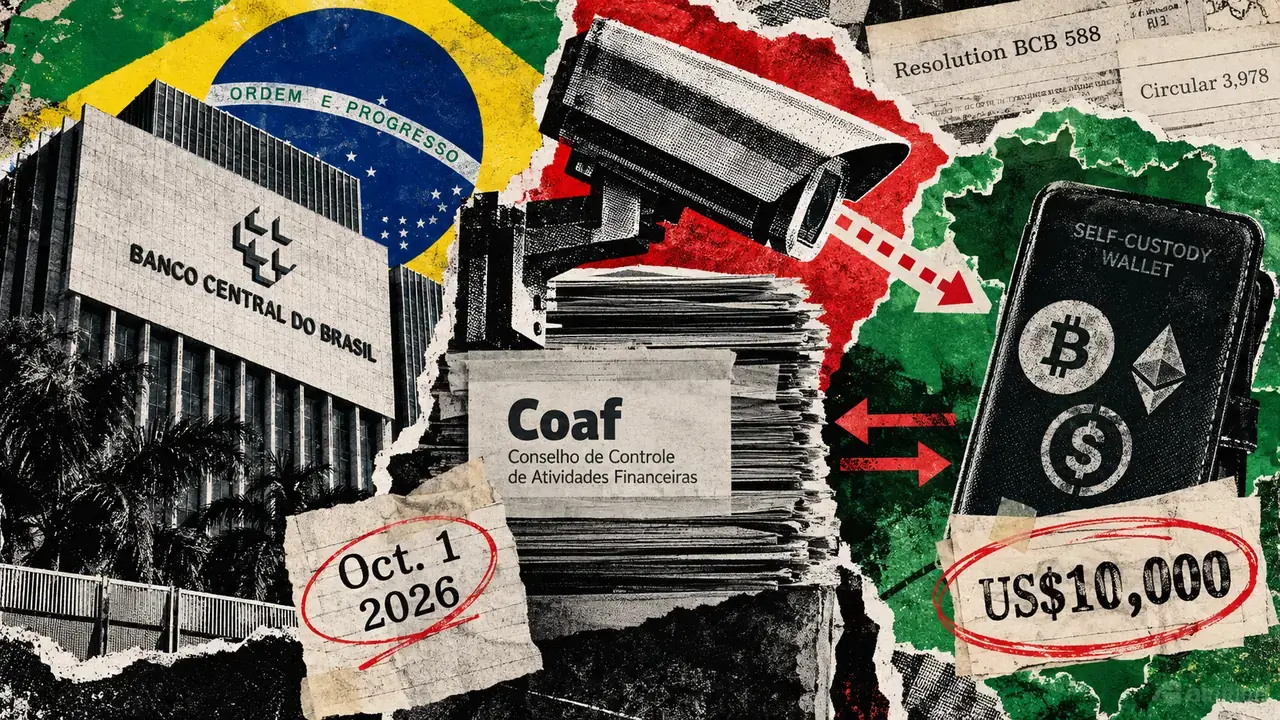
Starting in early 2026, all financial institutions authorized by the Central Bank of Brazil are now required to notify the Council for Financial Activities Control (Coaf) whenever a transfer to or from a user-controlled (self-custody) wallet hits the $10,000 mark. This reporting mandate applies to both domestic and international transfers, effectively closing the oversight gap on 'unhosted' wallets that previously operated with less visibility. The rule is designed to bring the massive $252 billion Brazilian digital asset market into closer alignment with traditional anti-money laundering (AML) standards.
This regulatory shift comes as Brazil continues to lead Latin America in crypto adoption, driven by both retail interest and institutional integration via platforms like NuBank. By focusing on the $10,000 threshold, the Central Bank is specifically targeting high-value transfers that could be linked to tax evasion or illicit activities. For the average retail user, these changes may not trigger immediate reporting, but for high-net-worth individuals and corporate entities, the friction of moving assets to cold storage has significantly increased.
From a regulatory perspective, this move reflects a broader global trend of authorities attempting to bridge the gap between centralized exchanges and the decentralized nature of self-custody. While the Brazilian government maintains that these rules are essential for financial integrity, privacy advocates argue that such monitoring could push users toward decentralized peer-to-peer (P2P) networks that bypass authorized institutions entirely. The geopolitical implication is clear: Brazil is positioning itself as a strictly regulated hub to attract global institutional capital that requires a clear legal framework.
Market participants should watch for potential shifts in liquidity as large-scale holders react to the new transparency requirements. There is a possibility that some capital may migrate to jurisdictions with less stringent self-custody reporting, though Brazil's dominant position in the region makes exit strategies difficult for local investors. In the coming months, the effectiveness of Coaf’s data processing will be a key indicator of whether this rule serves as a deterrent to illicit flow or a mere administrative hurdle for legitimate investors.
For crypto holders in the U.S. and abroad, Brazil’s decision serves as a bellwether for future regulations in other G20 nations. As the $10,000 reporting threshold becomes a standardized benchmark for digital assets, similar to the existing rules for cash transactions, the era of anonymous high-value self-custody transfers through regulated gateways appears to be coming to an end in major emerging markets.