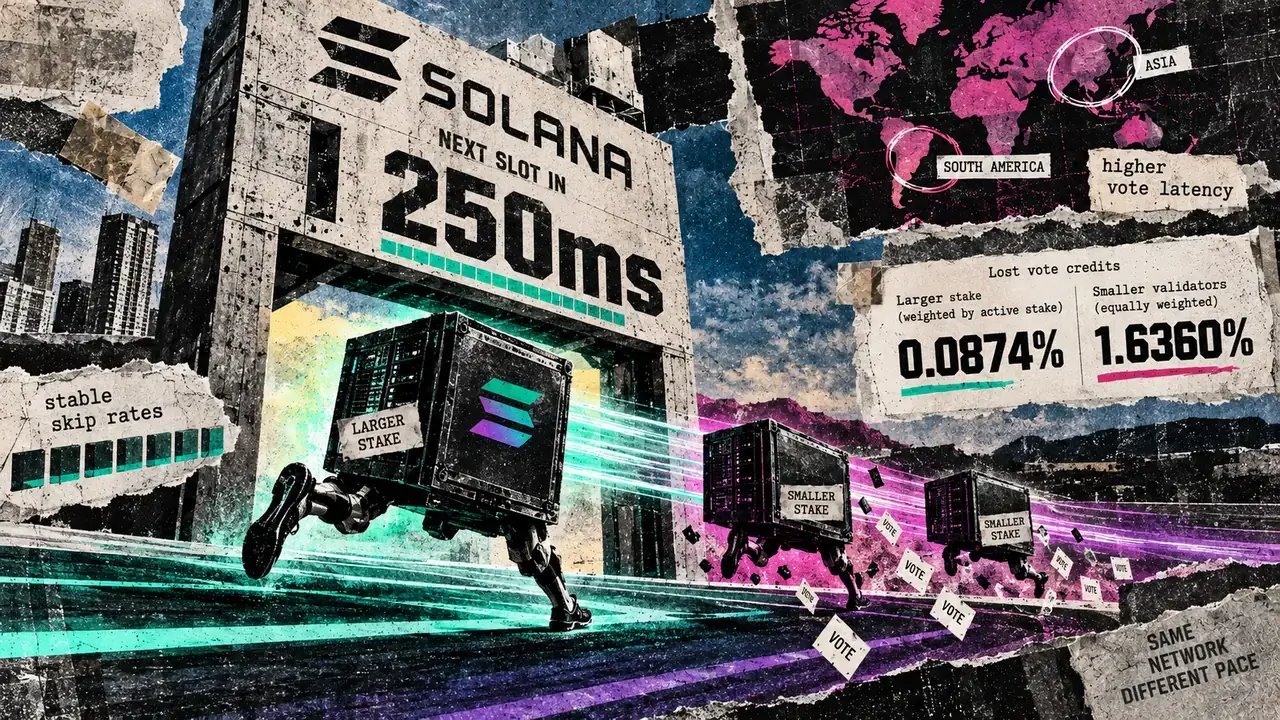
Low-stake validators on the Solana network are losing a larger share of reward-linked vote credits because the shift toward 250ms block times significantly narrows the window for successful vote submission. According to data from the Solana Foundation, smaller validators suffer from higher 'lost-credit fractions' compared to high-stake operations, who typically utilize more robust hardware and optimized network paths. Because vote credits are the primary metric for calculating staking rewards, this technical disparity means smaller participants are earning less than their larger counterparts for the same period of network uptime.
This finding comes at a critical time for the Solana ecosystem in 2026, as the community debates a further reduction in block times to 200ms. The Foundation's investigation suggests that while the network is achieving higher speeds, the technical requirements for keeping pace are creating a 'hardware tax' that favors centralized whale validators. For a network that prides itself on high throughput, this data reveals a friction point between raw performance and the decentralization needed to satisfy global regulatory expectations for proof-of-stake systems.
From a market perspective, if smaller validators become consistently less profitable, we may see a migration of staked SOL toward the top 20 validators. This concentration of stake can negatively impact the network's Nakamoto Coefficient—a measure of decentralization—potentially making SOL less attractive to institutional investors who prioritize censorship resistance. Furthermore, if smaller nodes are forced to exit the market due to declining APY, the physical distribution of the network could suffer, leading to increased vulnerability to localized outages or regional regulations.
Looking ahead, the Solana community is expected to focus on potential modifications to the reward mechanism to protect the interests of smaller nodes before the 200ms upgrade is implemented. Investors should watch for new Solana Improvement Proposals (SIPs) aimed at balancing latency and reward equity. The Foundation has indicated that the transition to even faster block times will likely be contingent on resolving these credit-loss discrepancies to ensure the long-term health of the validator ecosystem.