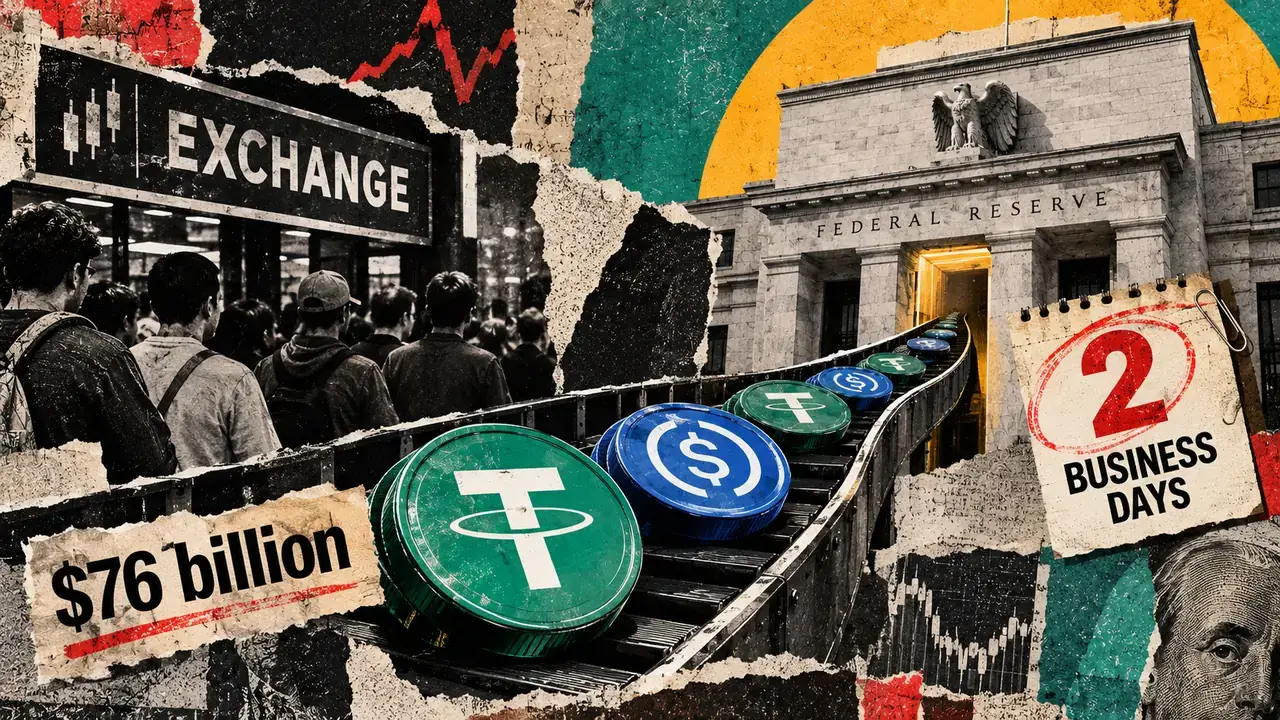
While the Federal Reserve’s new 2026 mandate requires stablecoin issuers to fulfill redemption requests within two business days, $76 billion in assets remains effectively blocked because these rules do not apply to retail crypto exchanges. The Fed's 'redemption clock' only governs the relationship between the issuer—such as Circle or Tether—and their direct institutional clients. Consequently, individual exchange users remain subject to the private terms of service, internal risk checks, and liquidity constraints of their specific trading platforms, which are not currently bound by the Fed's two-day payout guarantee.
The discrepancy became evident following a July 28, 2026, market snapshot that highlighted a massive bottleneck in the crypto ecosystem. Data shows that while issuers are complying with the new federal speed requirements, the 'last mile' of the transaction—getting funds from the exchange to a user’s bank account—is treated as a separate legal event. This has created a secondary layer of friction where funds are technically 'available' from the issuer but remain inaccessible to the retail public due to exchange-level processing backlogs.
From a regulatory standpoint, this gap underscores the Federal Reserve's current priority: systemic stability over retail convenience. By ensuring that major issuers have the liquidity to handle mass exits within 48 hours, the Fed aims to prevent a broader financial contagion. However, the lack of a unified redemption standard that extends to centralized exchanges has left a significant portion of the market in a state of 'functional illiquidity,' even when the underlying stablecoins are fully collateralized.
The market implications are immediate, as the $76 billion backlog could trigger local price decoupling on specific exchanges where withdrawal wait times exceed the 2-day window. If users perceive that their 'pegged' assets cannot be liquidated efficiently, they may trade at a discount compared to direct-issuer holdings. This serves as a stark reminder that regulatory protection at the issuer level does not automatically translate to consumer protection at the platform level.
Investors should closely monitor the US Treasury and the SEC for any upcoming guidance aimed at 'last-mile' stablecoin delivery. As long as this $76 billion remains separate from the Fed’s redemption clock, the industry can expect continued pressure for new legislation that forces exchanges to align their withdrawal policies with federal issuer standards. Watch for upcoming Congressional hearings in late 2026 regarding the 'Stablecoin Consumer Access Act' as a potential fix for this bottleneck.