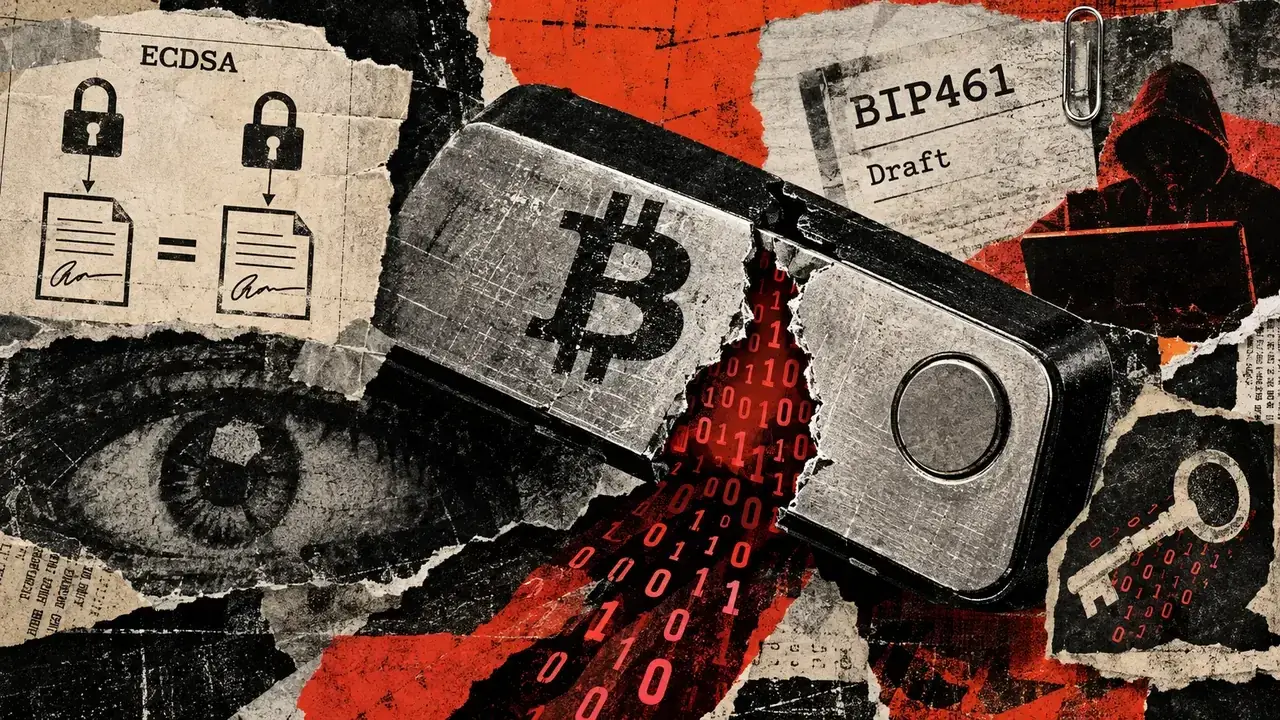
BIP461 prevents private key leaks by introducing a standard for reproducible ECDSA (Elliptic Curve Digital Signature Algorithm) signatures. By mandating a specific, deterministic way to generate the 'nonce'—a cryptographic number used during the signing process—BIP461 allows external software to verify that a signature was generated exactly as expected. If the signature produced by a hardware wallet deviates from this reproducible result, it serves as an immediate red flag that the firmware may be leaking sensitive private key data through the signature's structure.
This technical development addresses a sophisticated vulnerability known as a 'nonce-covert-channel' attack. In these scenarios, compromised or malicious firmware can embed bits of a user's private key into the signature itself. Because traditional ECDSA signatures are often non-deterministic, these leaks are virtually impossible for a user to detect without advanced forensic tools. BIP461 provides a standardized framework for wallets to be 'compliant,' enabling easy comparisons that flag these malicious deviations without needing to prove the specific intent of the firmware author.
In the current 2026 landscape, as US regulators increase scrutiny on self-custody solutions and consumer protection standards, BIP461 represents a vital step toward trustless hardware security. For both institutional investors and retail holders, this reduces the 'black box' risk associated with proprietary hardware wallet code. The move is viewed as a proactive effort by the Bitcoin developer community to strengthen the ecosystem's resilience against supply chain attacks and sophisticated state-sponsored malware that targets digital asset holders.
The implementation of BIP461 is expected to trigger a wave of updates across the hardware wallet industry. Major manufacturers will likely face pressure to adopt these standards to maintain their security certifications and market trust. Bitcoin users should watch for the integration of BIP461-compliant verification tools in popular software interfaces like Sparrow or Electrum. As these tools become mainstream, the ability to audit hardware wallet honesty will become a standard feature, further solidifying Bitcoin's position as the most secure decentralized asset.