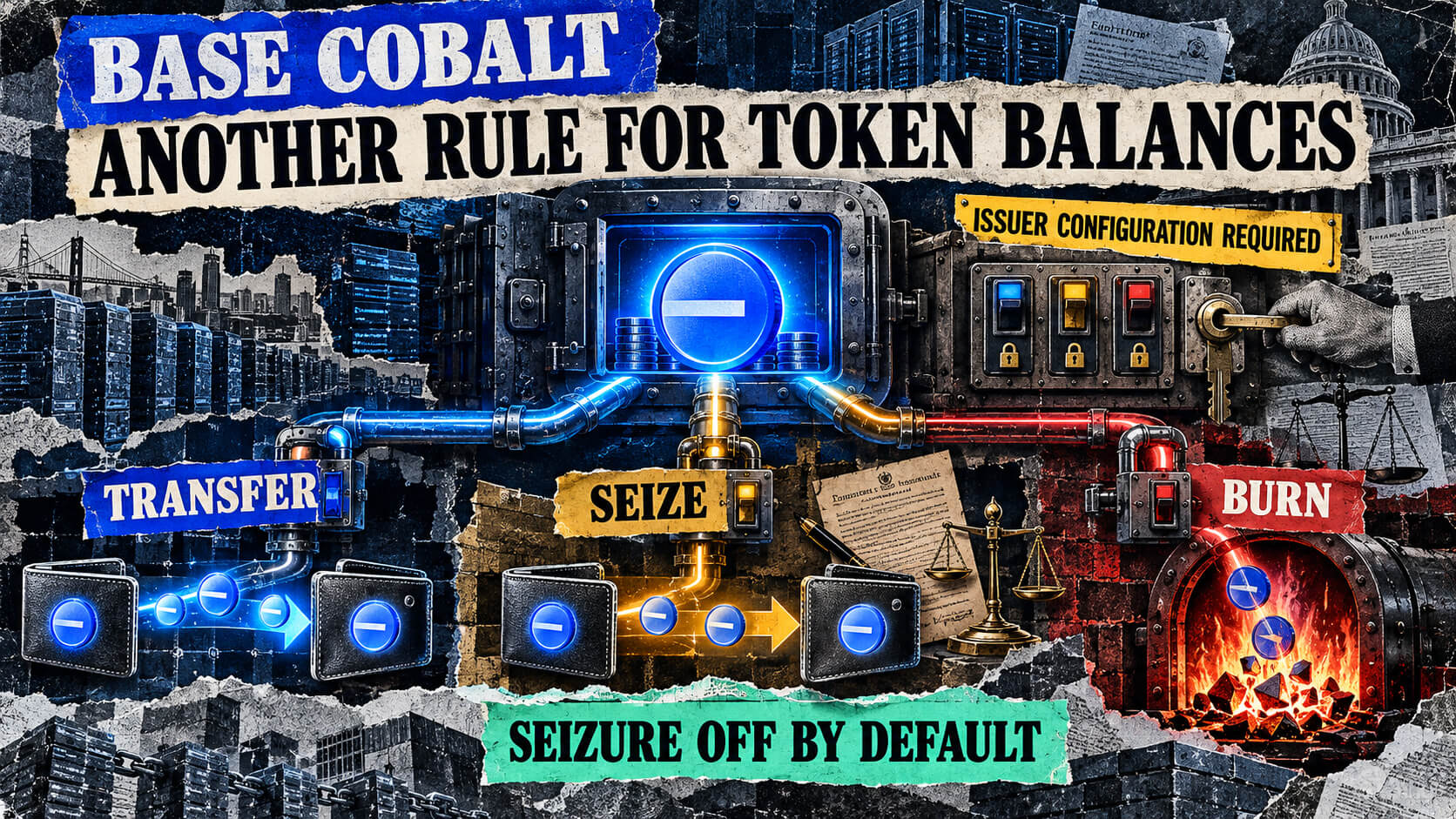
Base’s Cobalt upgrade, scheduled for September 30, 2026, at 18:00 UTC, will fundamentally change how B20 token issuers manage asset control by allowing them to opt into specific seizure policies. These policies operate independently of ordinary transfer restrictions, meaning an issuer could theoretically freeze or reclaim tokens under legal or regulatory mandates without affecting the general liquidity or transferability of the token for other users. This upgrade is a significant step in aligning the Base ecosystem with the rigorous compliance requirements often demanded by institutional investors and global financial regulators.
Technically, the Cobalt upgrade refines the smart contract logic for B20 tokens, which are a cornerstone of the Base Layer 2 ecosystem. By decoupling seizure authority from transfer locks, Base allows for more granular control. Previously, many compliance mechanisms required broader contract freezes that could disrupt market activity; Cobalt enables a 'surgical' approach to asset recovery or legal compliance. This is particularly relevant for Real World Assets (RWAs) and fiat-backed stablecoins that must adhere to varying international legal jurisdictions.
In the context of U.S. crypto regulation, this move by Coinbase-incubated Base is a clear signal toward institutional readiness. U.S. authorities, including the SEC and the Treasury, have frequently signaled that decentralized platforms must have mechanisms to prevent illicit finance. By integrating seizure capabilities directly into the protocol level for specific token types, Base is positioning itself as the preferred L2 for regulated financial entities who require 'clawback' features to satisfy Anti-Money Laundering (AML) and Know Your Customer (KYC) standards.
For market participants, the impact is two-fold. While institutional players will likely view this as a necessary maturation of DeFi infrastructure, retail users may harbor concerns regarding decentralization and the potential for centralized overreach. Investors should monitor which specific B20 issuers choose to opt into these policies following the September 30 activation, as this will distinguish between 'permissionless' assets and 'compliant' assets within the Base ecosystem.
Moving forward, the industry will be watching the 18:00 UTC activation closely to ensure a smooth transition. The broader implication for the Layer 2 landscape is significant; if Base successfully integrates these compliance tools without compromising network performance, it may set a new standard for how Ethereum scaling solutions balance the ethos of decentralization with the realities of global financial regulation.