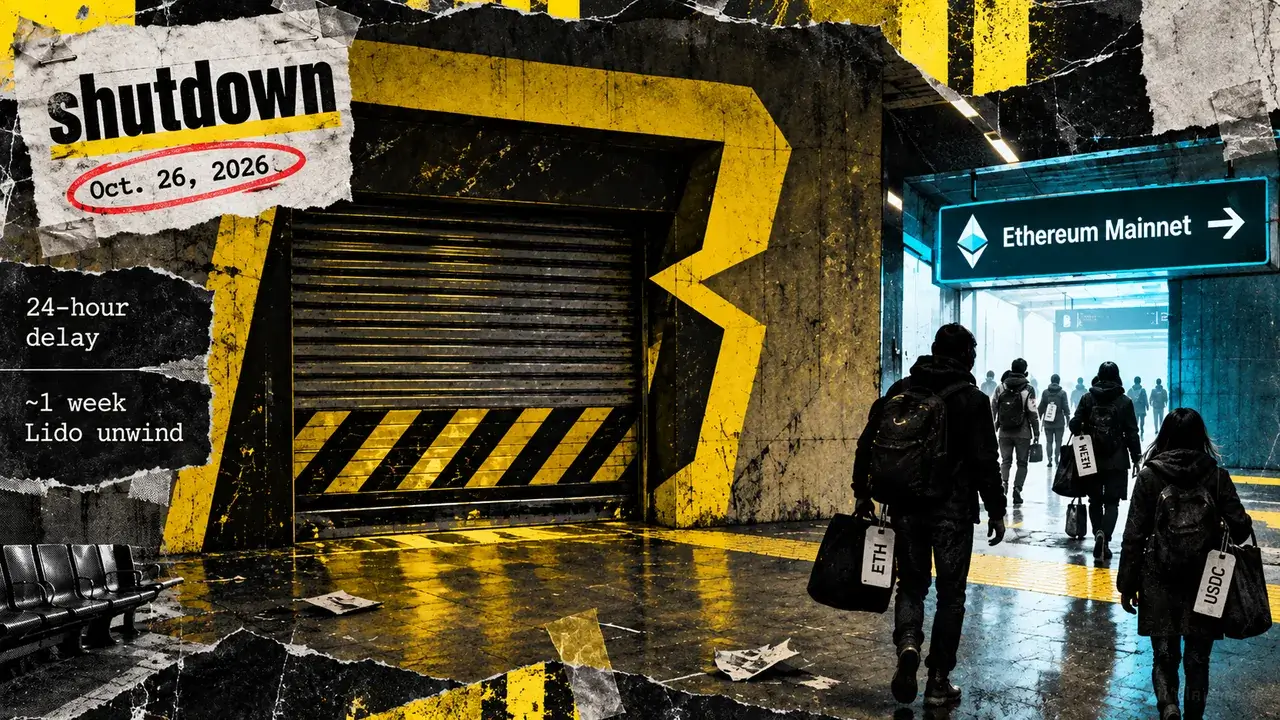
Blast has officially announced the permanent shutdown of its $20 million layer-2 network, establishing a mandatory exit deadline of October 26, 2026. To recover their assets, users must navigate the standard Blast interface and initiate withdrawals before the cutoff date. While the network is currently experiencing a temporary withdrawal pause, the team has confirmed that the bridge will be fully operational for a final window to allow for a transition back to the Ethereum mainnet.
The decision to sunset the network marks a significant contraction in the layer-2 scaling sector, which saw explosive growth in previous years. Despite managing $20 million in Total Value Locked (TVL), Blast struggled to maintain liquidity and developer interest in the face of stiff competition from larger ecosystems. The shutdown is being managed through a phased approach, but the lack of a secondary recovery mechanism after October 26 makes immediate action necessary for all liquidity providers and token holders.
For US-based crypto investors, this event serves as a stark reminder of the technical and liquidity risks inherent in smaller, non-dominant scaling solutions. While the shutdown does not appear to be triggered by specific US SEC or CFTC enforcement, the move reflects a broader trend of protocol consolidation as developers face higher operational costs and stricter compliance expectations regarding user fund accessibility. The firm Oct. 26 deadline is designed to minimize the long-term liability of maintaining bridge infrastructure for a defunct network.
Market observers should monitor the movement of these $20 million in assets, as the majority of the capital is expected to flow back into Ethereum (ETH) or competing L2s like Arbitrum and Base. The immediate priority for affected users is to track the status of the withdrawal pause; once lifted, a surge in network traffic is expected as the deadline approaches. Analysts will be watching to see if this closure triggers a 'flight to quality' among other mid-cap DeFi protocols in late 2026.