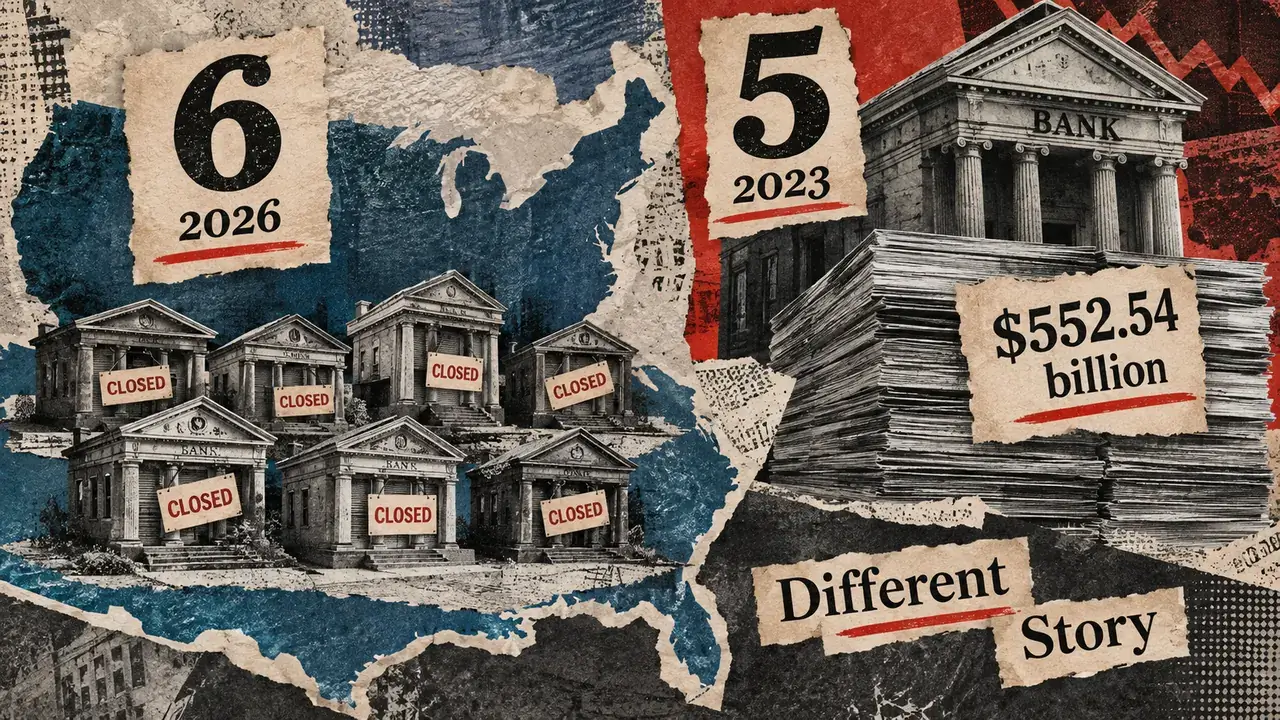
The 2026 US bank failures are far less severe than the 2023 crisis, despite a slightly higher frequency of individual bank closures. While six institutions have collapsed so far this year, their combined assets amount to just $1.43 billion. This stands in stark contrast to the five bank failures recorded in 2023, which included major players like Silicon Valley Bank and Signature Bank, resulting in a staggering $552.54 billion in lost or restructured assets.
The current wave of closures primarily involves smaller regional institutions rather than the tech-focused or crypto-adjacent banks that defined the 2023 volatility. The Federal Deposit Insurance Corporation (FDIC) has been able to manage these 2026 transitions with minimal market disruption, as these smaller entities lack the deep interconnectedness that previously triggered fears of financial contagion. For the crypto industry, which faced a massive liquidity crunch after the loss of Silvergate and Signature Bank three years ago, the current landscape remains relatively stable.
Market implications for Bitcoin and the broader digital asset space have been muted. Unlike the 2023 crisis, which famously triggered a 'flight to quality' toward Bitcoin as a hedge against banking instability, the 2026 failures have not caused a significant price surge or a breakdown in fiat-to-crypto on-ramps. Investors currently view these incidents as isolated cases of local mismanagement rather than a fundamental flaw in the national banking infrastructure.
Looking ahead, market participants should watch the FDIC’s 'Problem Bank List' for any signs that distress is spreading to mid-sized or larger lenders. While the $1.43 billion figure is currently manageable, a shift toward larger institutional failures could reignite interest in decentralized alternatives. For now, US-focused crypto investors should remain focused on regulatory developments and institutional ETF flows rather than these localized banking stresses.