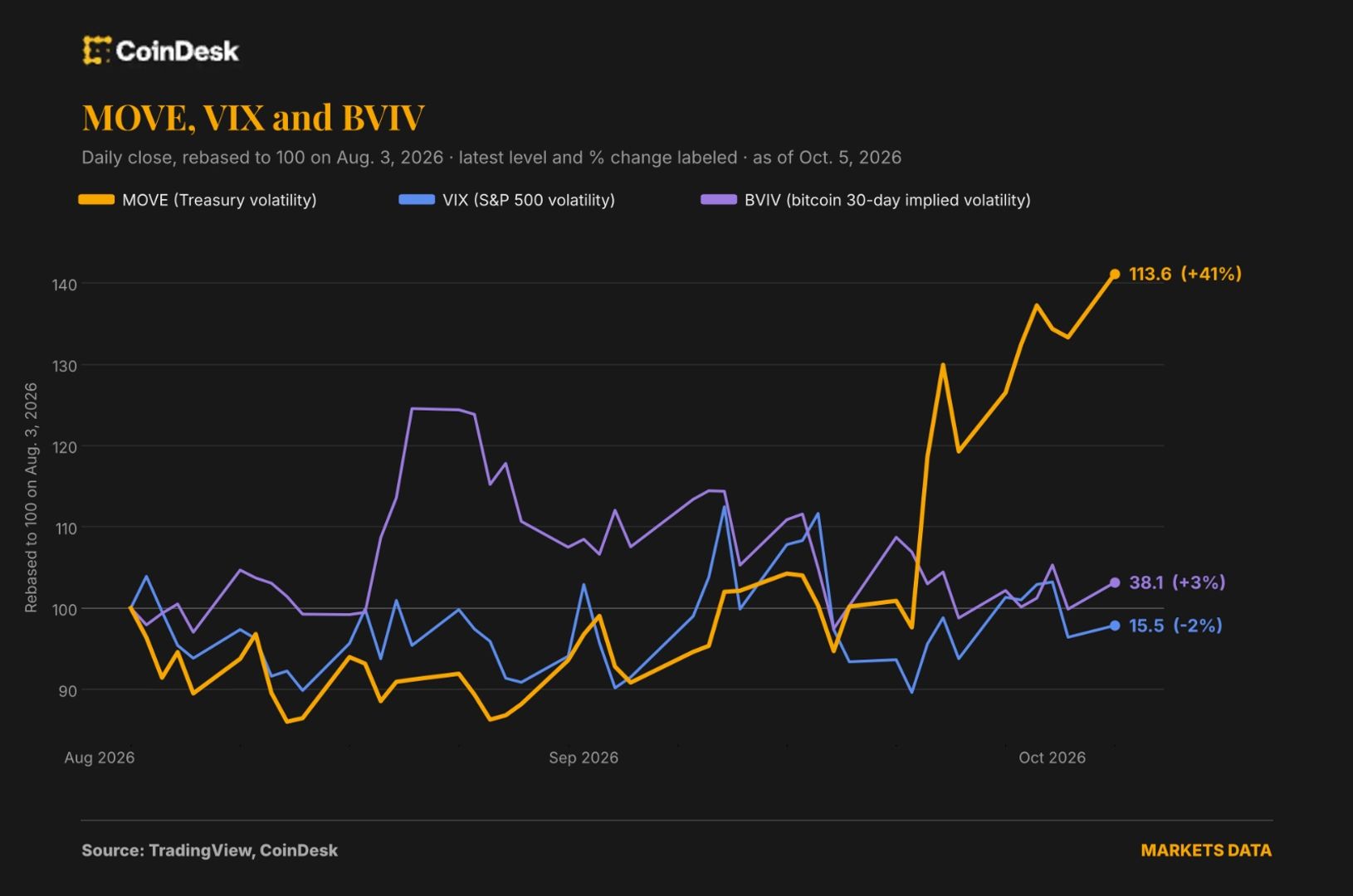
Bitcoin and US stocks are currently ignoring the October 2026 surge in bond market volatility because investors are betting on a 'soft landing' for the US economy and continued institutional demand for digital assets. While the MOVE Index—which tracks volatility in US Treasury yields—has reached levels that historically trigger a flight to safety, the crypto market remains buoyant. This divergence occurs as traders move away from seeing Bitcoin solely as a high-risk asset, instead treating it as a strategic hedge against the very fiscal uncertainty currently rattling the bond market.
The spike in bond volatility in early October 2026 is driven by shifting expectations regarding the U.S. Treasury’s Q4 issuance schedule and the long-term outlook for interest rates. Under normal market conditions, a rising 'Bond VIX' signals a tightening of financial conditions that devalues speculative assets. However, the market structure in late 2026 is bolstered by significant spot ETF inflows and a more robust regulatory framework that has anchored Bitcoin’s price floor, preventing the knee-jerk liquidations seen in previous years.
From a geopolitical perspective, the tension in the bond market reflects broader concerns about US debt sustainability, a theme that has historically been a recursive catalyst for Bitcoin growth. As traditional fixed-income markets become more unpredictable, the relative transparency of decentralized assets is becoming more attractive to global fund managers. This explains why, despite the turmoil in Treasuries, the crypto market has not yet seen the broad-based 'risk-off' sentiment that usually accompanies such volatility.
Moving forward, readers should closely monitor the $78,000 support level for Bitcoin and the 150-point mark on the MOVE Index. While the current decoupling is a sign of market maturity, a sustained period of extreme bond volatility eventually increases the cost of borrowing and leverage. If the Treasury market does not stabilize by the end of October 2026, the resulting liquidity crunch could force a delayed correction across both crypto and traditional equity markets.