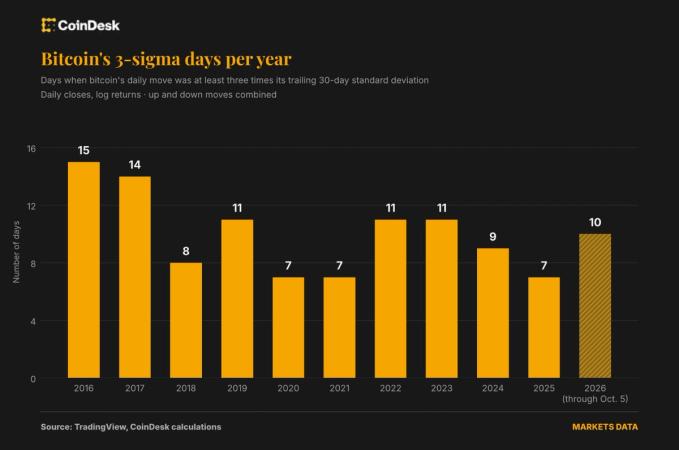
Bitcoin is seeing more frequent extreme price swings in 2026 because the market structure has evolved to favor concentrated 'fat-tail' events over consistent daily volatility. While average 30-day realized volatility has plunged compared to previous years, recent analysis shows there have already been 10 outlier trading days in 2026. This exceeds the frequency of extreme moves recorded during the 2018 bear market, suggesting that the current institutional-heavy market is prone to sudden, massive price breaks rather than gradual movements.
This phenomenon is largely driven by the dominance of institutional products, such as spot ETFs and sophisticated derivatives, which now dictate price action in the US market. Unlike the retail-driven cycles of 2018, the 2026 market environment experiences long periods of compression followed by violent expansions. These swings are often triggered by macro-economic data releases or institutional de-leveraging, where large-block trades hit thin order books during specific liquidity windows, causing rapid price adjustments.
The implications for investors are significant, as traditional risk metrics that rely on standard deviation and average volatility may now understate the actual danger of holding Bitcoin. For US traders, this 'new normal' means that extreme price events are no longer rare 'black swan' occurrences but are becoming a structural feature of the 2026 crypto landscape. These sharp movements can lead to cascading liquidations in the futures market, even when the broader market appears to be in a period of low activity.
Moving forward, market participants should watch the relationship between institutional net flows and intraday price gaps. As the market adapts to this high-impact environment, regulators like the SEC and CFTC may take a closer look at market stability and the potential need for standardized circuit breakers. Monitoring the frequency of these outlier days will be essential for anyone managing risk in a portfolio heavily weighted toward digital assets this year.