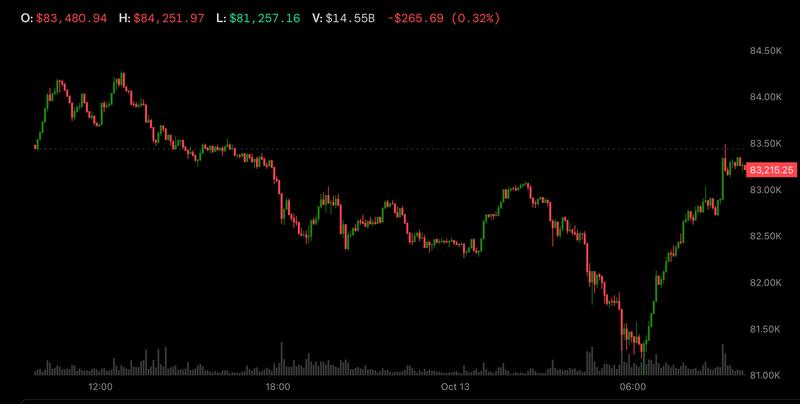
Bitcoin climbed back above $83,000 during early trading, successfully decoupling from a broader sell-off in South Korean semiconductor stocks and a decline in U.S. Nasdaq-100 futures. While traditional tech sectors faced pressure due to regional economic concerns in Asia and weakness in the chip sector, Bitcoin demonstrated independent strength, reclaiming the $83,000 level. This price action indicates that traders are increasingly viewing Bitcoin as a distinct asset class capable of moving against the grain of traditional macro headwinds.
The divergence was most notable in relation to the KOSPI index, where heavyweights like Samsung Electronics and SK Hynix saw sharp declines amid shifting global demand forecasts. Typically, crypto follows the lead of high-growth tech stocks, but the current 2026 market regime shows Bitcoin absorbing capital that is exiting the struggling semiconductor space. This suggests a shift where Bitcoin is no longer just a high-beta proxy for the Nasdaq but a destination for defensive positioning.
Geopolitical shifts and specific volatility in the South Korean financial landscape have likely spurred local capital to flow into digital assets as a hedge. Furthermore, the anticipation surrounding the U.S. Consumer Price Index (CPI) report on Thursday usually triggers a "risk-off" sentiment across all sectors. However, the brevity of Bitcoin's early dip suggests that institutional demand at the $80,000 support level is robust enough to withstand pre-report jitters in the equity markets.
For U.S. investors, this decoupling is a critical signal for portfolio diversification. If Bitcoin maintains its $83,000 floor despite weakness in traditional equity futures, it reinforces the narrative of BTC as a non-correlated macro asset. Readers should watch the CPI release closely; if inflation data arrives higher than expected, the durability of this decoupling will be the ultimate test for Bitcoin’s status as a safe-haven asset in 2026.