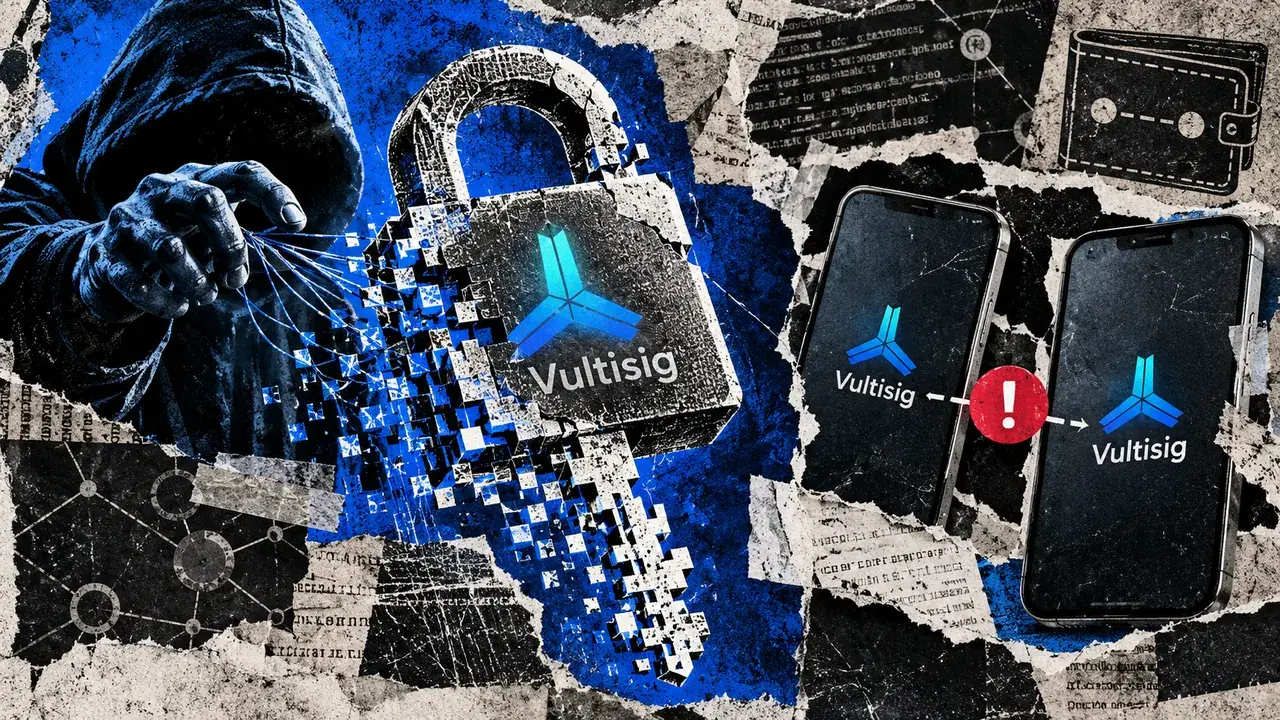
The Vultisig August 2026 update directly addresses a high-risk security flaw where a compromised signer could recover a wallet's private key by sending a series of malicious ECDSA messages. This vulnerability existed because the application failed to trigger a critical stop condition when detecting anomalous cryptographic requests, allowing an attacker to iteratively gather enough data to reconstruct the secret key. The latest patch mandates an immediate session termination upon detecting these malformed messages, effectively neutralizing the extraction path.
Technically, the exploit targeted the threshold signature scheme used by Vultisig's multi-party computation (MPC) architecture. In a scenario where one of the required signers was under an attacker's control, that participant could probe other nodes with specific mathematical queries. Because the software continued to process these queries instead of halting, the attacker could eventually bypass the privacy barriers of the MPC protocol to obtain the full private key, compromising all assets held in the wallet.
This fix comes at a time when US regulators, including the SEC, are increasing their oversight of DeFi middleware and self-custody solutions in 2026. As the 'Digital Asset Security Act' begins to influence how wallet providers are held liable for software vulnerabilities, Vultisig's proactive disclosure and rapid patching serve as a benchmark for institutional-grade security. For US-based users and fund managers, this update is mandatory to maintain compliance with emerging cybersecurity standards for digital asset custody.
Market participants should view this as a necessary step in the evolution of MPC technology. While the discovery of a private key leak vulnerability is concerning, the swift resolution prevents a potentially catastrophic loss of funds across the multi-chain ecosystem. Users are advised to verify their application version and update immediately. The industry will now be watching to see if similar vulnerabilities exist in other threshold-signature-based wallets, as security researchers intensify their focus on cryptographic message handling in late 2026.