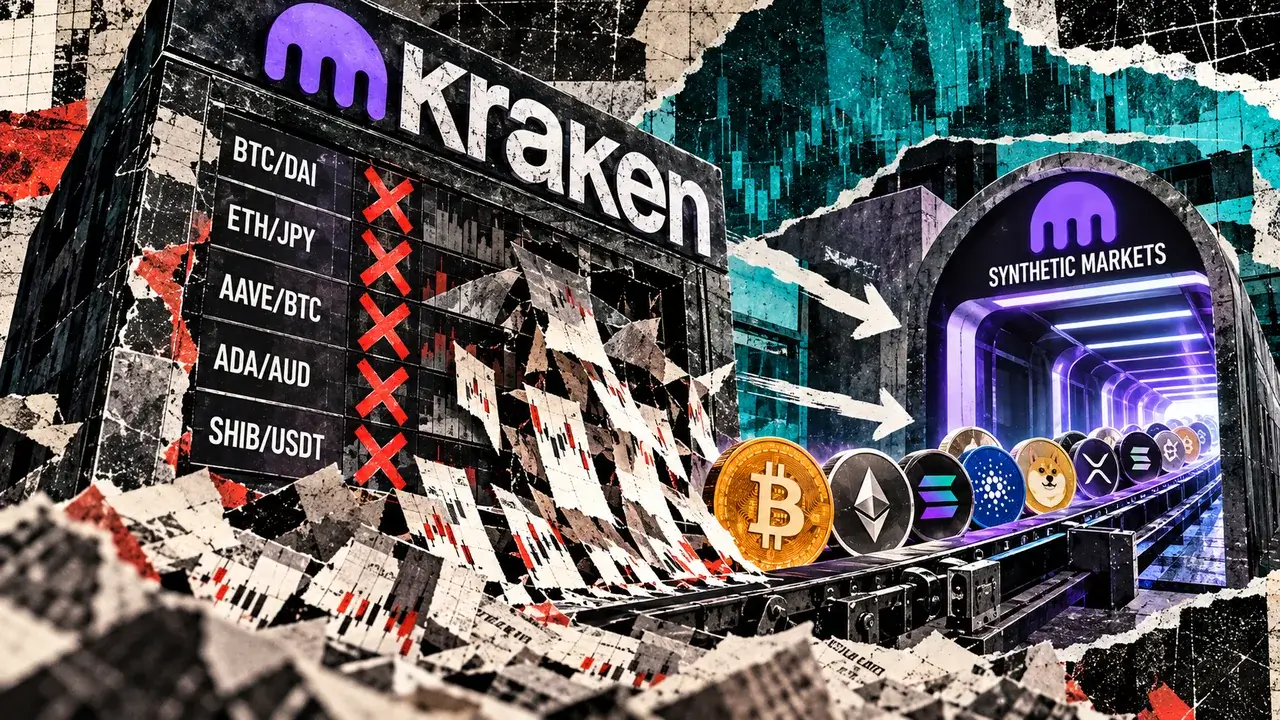
Kraken’s sweeping 2026 trading overhaul involves the immediate cancellation of all existing orders across 176 crypto markets to facilitate a transition to synthetic market replacements. Under this new system, limit orders placed on the affected pairs will no longer qualify for traditional maker rebates or lower maker fee tiers; instead, they will be processed with standard taker fees. This structural change significantly alters the cost of liquidity provision for both retail and institutional traders who rely on these specific order books for high-frequency or cost-sensitive strategies.
The migration requires users to manually re-enter their positions once the new synthetic markets go live, as current order books will be entirely purged without a direct transfer of existing data. Kraken’s decision to move toward synthetic pairs appears aimed at optimizing liquidity across fragmented altcoin markets. However, the move has drawn scrutiny from the trading community for effectively increasing the cost of trading for those who previously utilized the exchange’s maker-taker fee model to minimize operational overhead.
For US-based traders, this shift reflects a broader 2026 trend where major exchanges are consolidating liquidity through internal synthetic matching engines. This may be a strategic response to evolving liquidity requirements and market structure regulations that demand more robust depth in smaller-cap assets. By streamlining 176 of its less liquid markets, Kraken aims to provide a more stable trading experience, though it comes at the price of traditional order book transparency and higher execution costs for liquidity providers.
Market participants should immediately audit their open positions and bot settings to ensure they are not caught off guard by the order cancellations. Moving forward, the industry should watch whether other tier-1 platforms, such as Coinbase or Gemini, adopt similar 'synthetic' models for their altcoin markets. If this becomes a standard practice in 2026, the era of low-cost limit order placement on secondary crypto markets may be coming to an end.