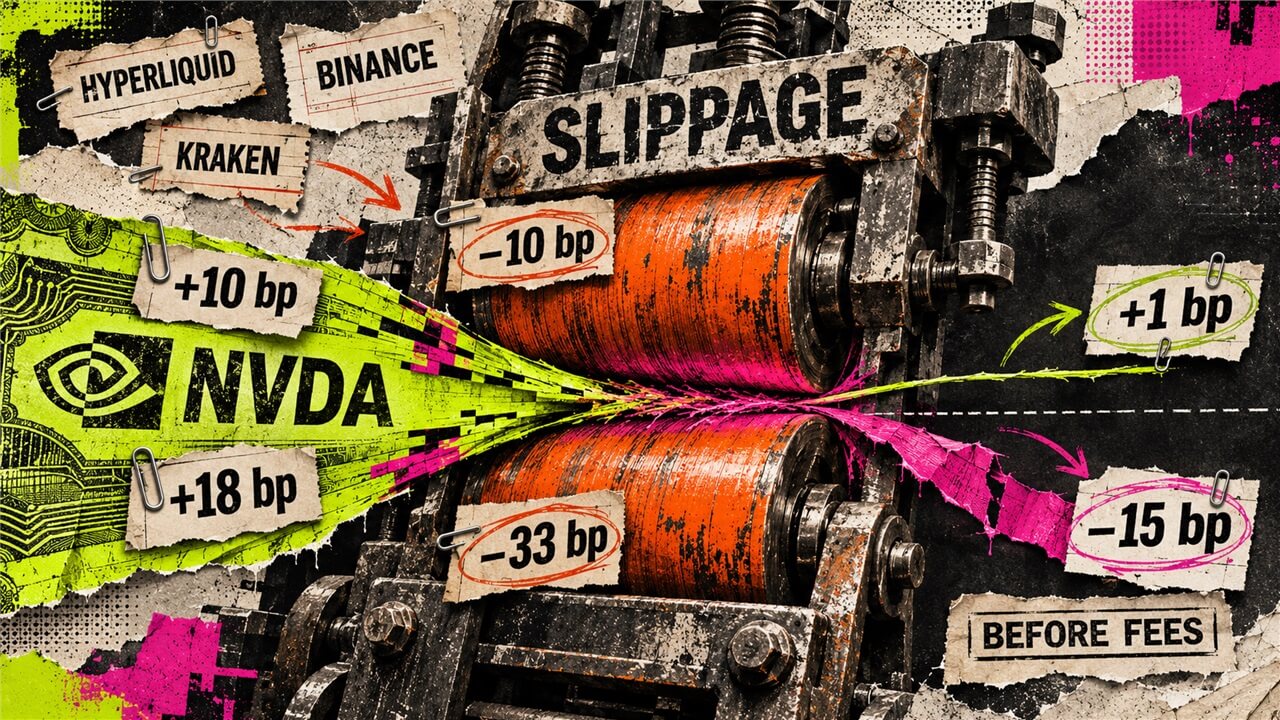
In 2026, slippage and share adjustment fees have become the primary barriers preventing retail traders from successfully executing arbitrage on Nvidia stock tokens. Despite visible price discrepancies between decentralized protocols and traditional markets, the actual execution of these trades often results in a net loss. Recent data comparing $1,000 trade sizes reveals that while some spreads offer a marginal 1 basis point gain, others result in a negative 15 basis point return once fees and slippage are factored in, effectively crushing the arbitrage opportunity for all but the most sophisticated institutional players.
This trend highlights a persistent liquidity issue within the Real-World Asset (RWA) sector. While the tokenization of US equities like Nvidia promised 24/7 global access and price efficiency, the fragmented nature of liquidity pools in 2026 means that large buy or sell orders significantly move the market price. For US-based investors, this technical hurdle is compounded by the varying methods protocols use to adjust for stock splits or dividends, adding a layer of complexity that makes automated arbitrage bots more likely to fail without deep liquidity backing.
From a regulatory standpoint, the SEC has continued to monitor the synthetic asset market throughout 2026, specifically looking at whether these tokens provide "best execution" for retail participants. The inability of retail traders to capture these spreads due to high friction costs could lead to renewed calls for stricter liquidity requirements for platforms offering tokenized securities. Furthermore, the geopolitical demand for US artificial intelligence exposure via crypto remains high, yet these technical inefficiencies suggest that the infrastructure is not yet mature enough to replace traditional brokerage accounts.
Investors should watch for the integration of cross-chain liquidity aggregators that aim to pool Nvidia token depth from multiple networks. If protocols can reduce the slippage impact through better automated market maker (AMM) designs or by incentivizing professional market makers, the arbitrage window may reopen. Until then, the cost of entering and exiting these positions remains the single greatest threat to the profitability of synthetic equity trading in the crypto ecosystem.