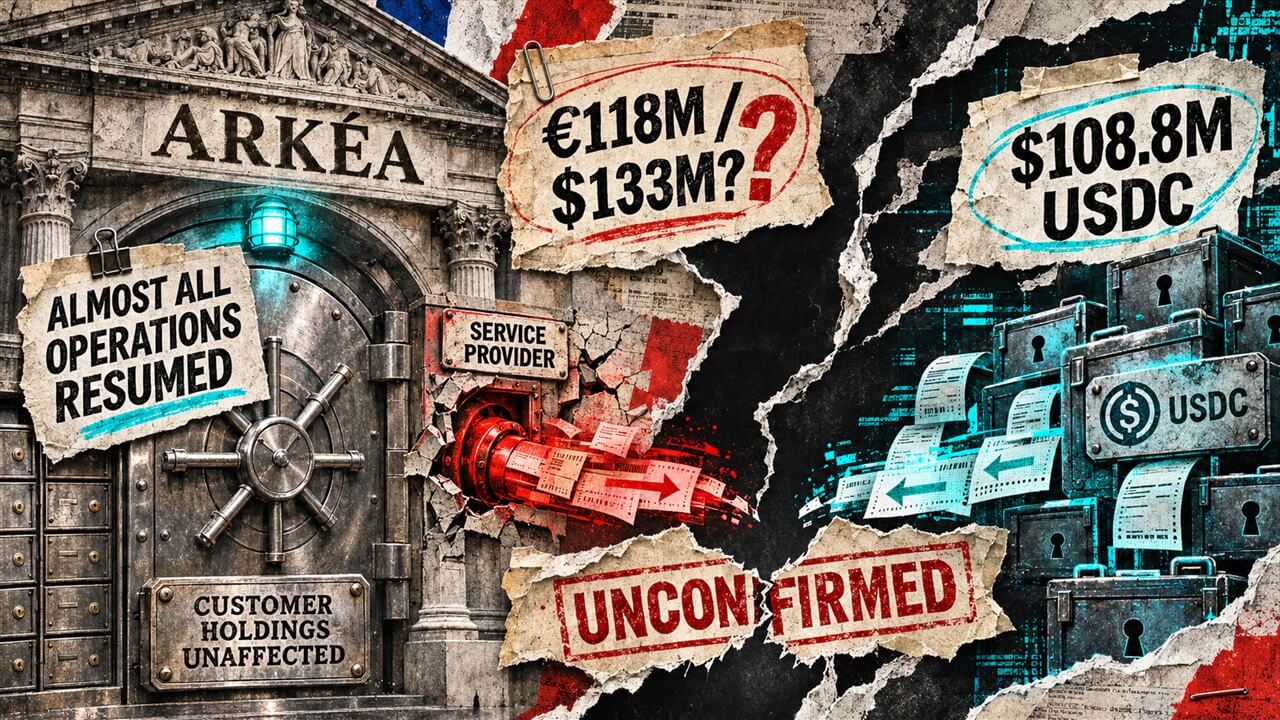
French banking group Arkéa has officially resumed transfer operations following a major $133 million security breach, though the institution remains silent on a suspected $108.8 million loss in USDC. While the bank confirmed that attackers gained access to its accounts via a third-party provider's platform, it has not yet verified if the significant trail of stablecoin movements identified by on-chain analysts belongs to the bank or its clients. This lack of confirmation leaves a massive gap in the accountability of the stolen funds as the investigation enters its next phase.
The attack specifically targeted the interface between Arkéa and a service provider, rather than the bank’s internal core systems, showcasing a critical vulnerability in how traditional financial institutions interact with digital asset ecosystems. Investigators have tracked $108.8 million in USDC moving through a series of suspicious wallets, but the legal link between these transactions and Arkéa’s $133 million total loss remains unproven. The bank’s decision to resume services suggests that the immediate technical threat has been neutralized, even as the financial recovery remains uncertain.
From a regulatory perspective, this incident arrives at a time of heightened scrutiny under the 2026 updated MiCA frameworks in Europe. Regulators are increasingly concerned about the 'bridge risk' where vulnerabilities in third-party crypto custodians or payment processors can jeopardize the stability of traditional banks. U.S.-based observers and USDC issuers are monitoring the situation closely, as the involvement of a major dollar-pegged stablecoin in a European bank hack raises questions about international digital asset recovery and the jurisdictional reach of stablecoin freezes.
For the broader crypto market, the Arkéa breach serves as a stark reminder of the risks associated with institutional crypto adoption. While USDC’s peg has remained stable despite the news, the event could lead to increased compliance costs and tighter auditing requirements for banks that utilize stablecoins for settlement. Investors should watch for Arkéa’s final forensic report and potential statements from the European Banking Authority, which could set new security benchmarks for third-party provider integrations across the Eurozone.